Anyone who becomes aware of any student organization conduct violation, including but not limited to hazing, is encouraged to immediately report the incident, including all observed or learned details. Reporting options include the following:
MSU Department of Police and Public Safety (DPPS)
Any incident involving a crime, an emergency, or imminent threat to the health or safety of any person should be reported immediately to the police.
Emergency phone: 911
In person: 1120 Red Cedar Road, East Lansing, MI 48824
Non-emergency phone: 517-355-2221
Office of Student Support & Accountability (OSSA)
Acts or potential acts that do not constitute an emergency should be reported to OSSA.
In person: 556 E Circle Drive Room 175, East Lansing, MI 48824
Phone: 517-884-0789
Email: ossa.soconduct@msu.edu
Online: OSSA public reporting form
MSU Misconduct Hotline
Concerns may also be reported anonymously through the MSU Misconduct Hotline
Phone: 800-763-0764
Online: MSU Misconduct Hotline Form
Those impacted by organization misconduct, including hazing, may choose to report to law enforcement, to the university, to both or to neither as the individual may choose.
Employees designated as Campus Security Authorities (CSAs) under the Clery Act may have additional reporting responsibilities. Under the Mandatory Reporting for Relationship Violence, Sexual Misconduct and Stalking Policy, university employees and volunteers, as defined under the policy, may also have reporting requirements.
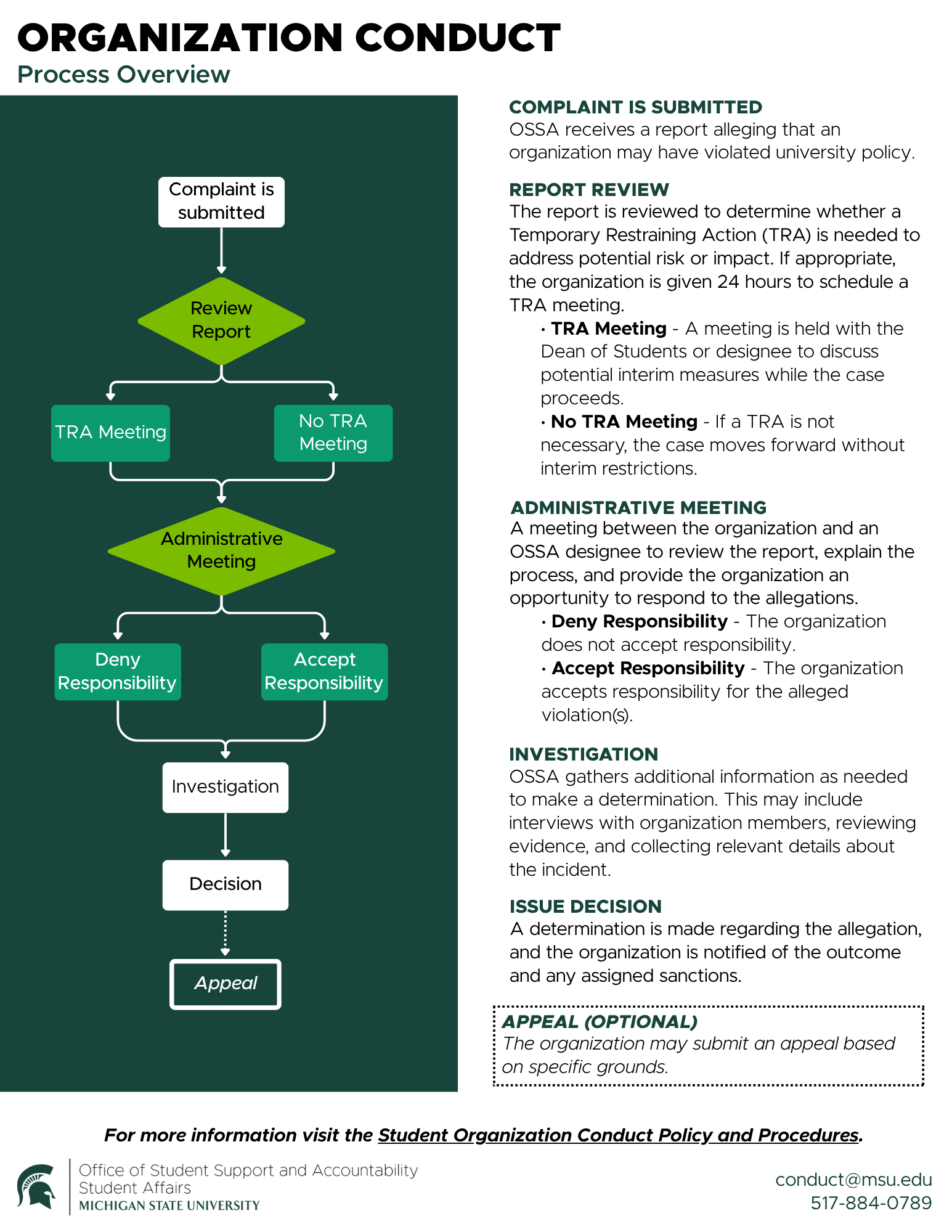
Organization Conduct Process Overview
Download the Organization Conduct flowchart.
- Complaint is submitted: OSSA receives a report alleging that an organization may have violated university policy.
- Report Review: The report is reviewed to determine whether a Temporary Restraining Action (TRA) is needed to address potential risk or impact. If appropriate, the organization is given 24 hours to schedule a TRA meeting.
- TRA Meeting - A meeting is held with the Dean of Students or designee to discuss potential interim measures while the case proceeds.
- No TRA Meeting - If a TRA is not necessary, the case moves forward without interim restrictions.
- Administrative Meeting: A meeting between the organization and an OSSA designee to review the report, explain the process, and provide the organization an opportunity to respond to the allegations.
- Deny Responsibility - The organization does not accept responsibility.
- Accept Responsibility - The organization accepts responsibility for the alleged violation(s).
- Investigation: OSSA gathers additional information as needed to make a determination. This may include interviews with organization members, reviewing evidence, and collecting relevant details about the incident.
- Issue Decision: A determination is made regarding the allegation, and the organization is notified of the outcome and any assigned sanctions.
- Appeal (optional): The organization may submit an appeal based on specific grounds.